
In short
- Start with the days your client can really train, not with the exercises.
- Every exercise with sets, reps, effort (RIR), rest and a short note.
- Change the plan in draft and publish it in one go: your client always sees a single version.
Start with the week, not the exercises
Before picking a single exercise, ask how many days your client can train in a normal week, not their best one. Three sessions that get done are worth more than five left half-finished.
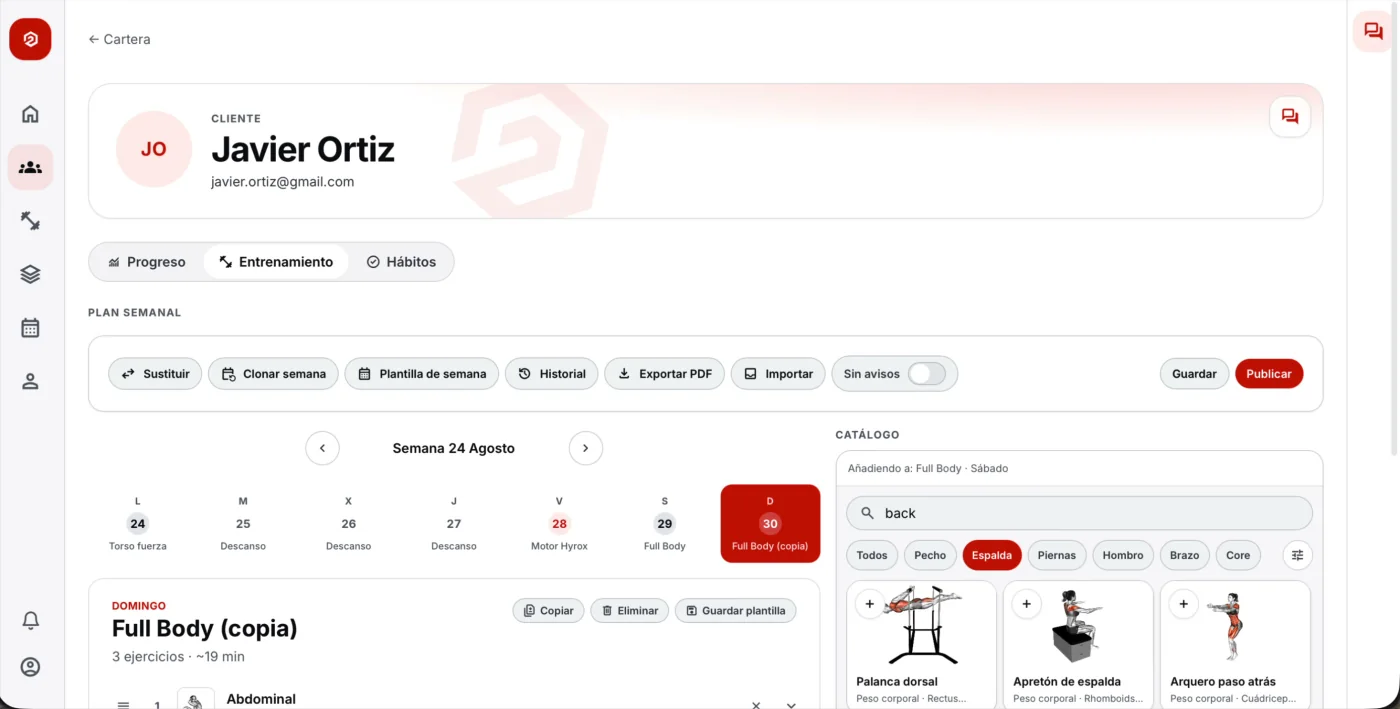
With the days settled, spread the work: what happens each day, how long it lasts and which days are rest. That’s the template week, and it’s what your client needs to see at a glance.
What every exercise should include
If your client trains alone, everything you’d say on the gym floor has to be written down. At the very least:
- Sets and reps, or a range (“8–10”).
- Effort, for example with RIR: the reps left in the tank at the end of the set. RIR 2 means “you could have done two more”.
- Rest between sets.
- A short note with what matters most: “lower with control”, “if the knee hurts, no weight”.
That way your client doesn’t have to guess, and when they log what they did you can compare it with what you asked for.
Templates so you never start from scratch
Most of your clients fit a handful of structures: three full-body days, upper and lower, a comeback week after a holiday. Save them as session or week templates and adapt each copy to the client: their injuries, their equipment, their days.
Same with last week: if it worked, clone it and change only what needs changing.
Change the plan without confusing your client
The problem with editing a shared document is that your client sees changes half-made. Work in draft and publish when the week is complete. That way there’s always one valid version.
And keep the previous versions: when something stops working, knowing what you changed and when saves you a lot of time.
Review against what they trained, not what you planned
Before building next week, look at what they actually did: which sessions they completed, with what weights and reps, and which ones they skipped and why. If they skipped the same session two weeks in a row, the problem is the plan, not the client.